The Four Temperaments Compatibility Chart: All Ten Pairings Explained
A plain compatibility chart for the four temperaments: what each of the ten possible pairings tends to do well, where it tends to grind, and what the tradition actually claims about matching natures.
People ask the chart question before any other. Which temperaments go together? Which should stay apart? The honest answer is that every pairing works and every pairing has a known weak seam, and a chart is only useful if it shows both. So here is the whole grid, all ten pairings, with the strength and the friction of each, followed by what the old sources do and do not say about matching.
If you do not yet know your own leading nature, the test takes about three minutes and gives you a full blend rather than a single label. The chart below reads best when you know your top two.
How to read the chart
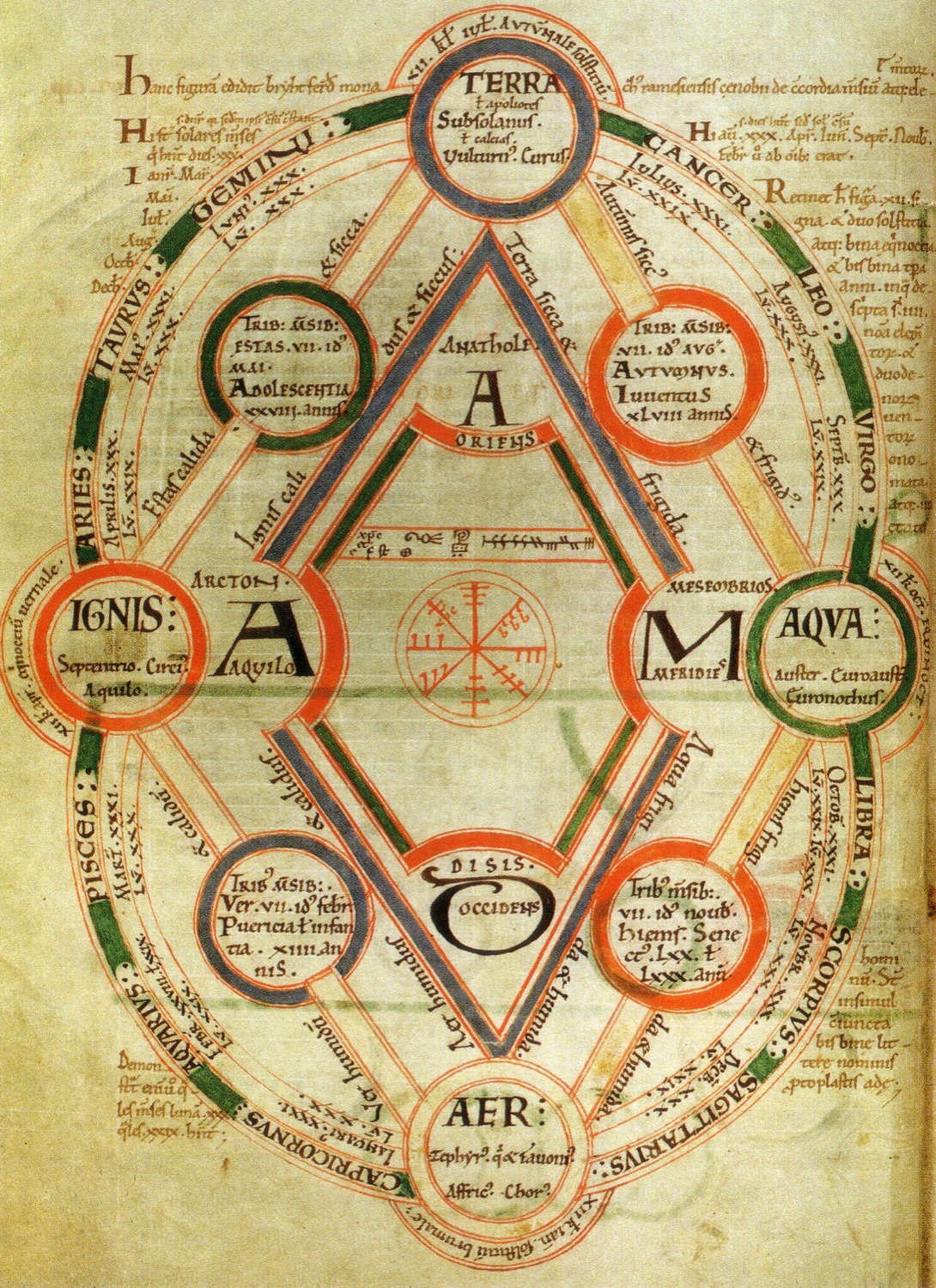
Four temperaments make ten pairs: four in which both people share a nature, six in which they differ. The tradition places the four on two axes, warm against cold and dry against moist. The sanguine is warm and moist, the choleric warm and dry, the melancholic cold and dry, the phlegmatic cold and moist. A pair that shares an axis has common ground; a pair that shares neither is a pair of opposites. That single fact predicts most of what follows.
One rule before the grid. Compatibility here means the shape of the fit, not its quality. Two well-matched people can fail and two opposites can build a long and steady life. The chart tells you where to look, not what will happen.
The four like pairs
Sanguine with sanguine. Strength: warmth on tap, easy affection, a household that is rarely quiet or dull. Friction: two people who both start things and neither finishes them, and a shared allergy to hard conversations. The pair needs one dull habit they both keep, a budget, a calendar, an evening without guests.
Choleric with choleric. Strength: enormous joint capacity. Two cholerics can build a business or raise a family with a speed that startles everyone around them. Friction: two captains, one ship. Every decision is a contest unless the territory is divided early and clearly. The pair thrives on separate domains and shared goals.
Melancholic with melancholic. Strength: depth, loyalty, and being fully understood without explaining. Friction: two people who both take things to heart and both remember. A bad week can become a bad season because neither one lightens the air. The pair does well with a standing rule that one of them, by turns, is in charge of perspective.
Phlegmatic with phlegmatic. Strength: peace. Genuine, durable, low-drama peace, and a tolerance for each other's quiet that other pairs envy. Friction: drift. Nobody pushes, so plans stay plans and small resentments stay unspoken because raising them feels like too much. The pair needs a fixed point, a monthly review, a friend who asks hard questions.
The two opposite pairs
These share no axis at all, and they are the pairs the popular literature loves, because they balance so visibly.
Sanguine with melancholic. Strength: light and depth. The sanguine draws the melancholic out into the world; the melancholic gives the sanguine's feelings somewhere to land and last. Friction: the sanguine reads the melancholic's quiet as rejection, the melancholic reads the sanguine's ease as shallowness, and both are wrong. The fix is translation. This is the pair most helped by learning how the other one loves. See the head to head for the full contrast.
Choleric with phlegmatic. Strength: probably the most stable mixed pair in the tradition. One drives, one steadies; one decides, one absorbs. Friction: the choleric pushes, the phlegmatic withdraws, and the withdrawal reads to the choleric as defiance while the pushing reads to the phlegmatic as contempt. Left alone the pattern hardens into one loud person and one silent one. The pair needs the choleric to ask rather than tell and the phlegmatic to answer out loud. See choleric vs phlegmatic.
The four neighbouring pairs
These share one axis, so they agree on tempo or on tone but not on both.
Sanguine with choleric (both warm). Strength: energy, optimism, momentum. This is the pair that hosts, launches, moves house on a whim and makes it work. Friction: both want the room. The sanguine wants to be liked in it, the choleric wants to run it, and a good evening can turn on who got the last word. Compare them side by side.
Melancholic with phlegmatic (both cold). Strength: a calm, careful, deeply private life that suits both. Neither needs an audience. Friction: neither initiates. The melancholic waits to be sure, the phlegmatic waits to be asked, and things that matter go unsaid for years. The pair needs scheduled honesty. Melancholic vs phlegmatic shows how alike and how different they are.
Choleric with melancholic (both dry). Strength: standards. Both are serious, both finish what they start, and together they can achieve a great deal with very little waste. Friction: both are critical, and the criticism cuts in different directions. The choleric is blunt and moves on; the melancholic is quiet and does not. See choleric vs melancholic.
Sanguine with phlegmatic (both moist). Strength: the easiest pair to live with. Both are soft, both forgive, and the sanguine's noise sits comfortably on the phlegmatic's calm. Friction: nobody steers. Decisions get made by whoever cares more, which is usually the sanguine and usually briefly. See sanguine vs phlegmatic.
The chart in one glance
- Most balanced: choleric with phlegmatic, sanguine with melancholic. Opposites that complete each other and must learn each other's language.
- Most alike: the four same-type pairs. Easiest to understand, hardest to correct, because both share the same blind spot.
- Most comfortable: sanguine with phlegmatic. Warm, soft, and short on direction.
- Most productive: choleric with melancholic, choleric with choleric. High output, high standards, low patience.
- Most private: melancholic with phlegmatic. Deep, calm, and quiet to a fault.
- Most lively: sanguine with sanguine, sanguine with choleric. Never dull, sometimes exhausting.
What the tradition actually says
It is worth being clear about what is old here and what is new. The classical sources describe individual constitutions. Galen's treatise on mixtures sorts bodies by their blend of qualities and says nothing about who should marry whom. Kant, writing in 1798, insisted that the temperaments do not mix at all within one person, which is why he counted exactly four, and he was not thinking about couples either.
The compatibility chart is a twentieth century layer. Popular writers on the four temperaments, especially in the American self-help tradition from the 1980s onward, turned an old typology into marriage and family advice, and the charts you find online descend from that work. That does not make them useless. It means they are a map of tendencies drawn by observant people, not an ancient law. Read this one the same way.
Two cautions follow. First, most people are a blend, and your second temperament often decides how a pairing actually feels day to day. A sanguine with strong melancholic beneath will meet a melancholic partner very differently from a sanguine with choleric beneath. Second, the chart describes natures, not effort. Every friction above has a stated remedy, and the remedy is always something a person can choose to do.
For how the pairs play out beyond the chart, in the daily weather of a relationship, read the four temperaments in relationships.
Frequently asked questions
Which temperaments are most compatible?
Which temperaments should not be together?
How many temperament pairings are there?
Is the four temperaments compatibility chart scientific?
Do temperaments mix within one person?
Sources
- Hippocratic corpus, On the Nature of Man, ch. 4, the earliest statement of the four humours as the constituents of the body.
- Galen, De temperamentis (On Mixtures), Book I, on the blends of warm, cold, dry and moist that define a constitution.
- Immanuel Kant, Anthropology from a Pragmatic Point of View (1798), Book II, 'On temperament', where the four are treated as simple and unmixed.
- Florence Littauer, Personality Plus (1983), a representative example of the modern popular literature that turned the typology into relationship advice.
Find your temperament
Take the test